
Solens slægt – a national romantic queer opera
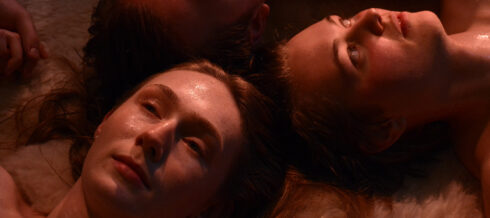
Ea Wiimh is studying composition at the Royal Academy of Music in Aarhus and has chosen to write an opera as her final master’s project: Solens slægt (The Lineage of the Sun). At this concert, a 30-minute excerpt from the new opera is presented; the work is still under development.
Ea Wiimh herself describes the opera as a national-romantic queer opera about the Nordic Bronze Age—a new, microtonal electroacoustic “work in progress.” She describes her project as follows:
About the opera
After immersing myself in the Nordic Bronze Age, I have realized how deeply Christianity still permeates our society and how we are nowhere near as progressive as we tell ourselves we are as Danes.
In the Bronze Age, sex was inextricably linked to religious rituals and the elite. Consider your own reaction—and what it stems from—when I put the religious sex rituals of the Bronze Age into a contemporary perspective: If we still practised the religion of the Bronze Age, Mette Frederiksen and Lars Løkke would have had sex live on TV every New Year’s Eve to ensure a prosperous coming year.
Plot
We follow the two semi-divine twin brothers, Hengest and Horsa, and their sister, the sun priestess Sól, on their journey to the annual fertility festival. The vulnerable twin brother, Hengest, has long fallen behind in his religious duties. His jealousy toward Sól and Horsa grows as their bond strengthens in light of his inadequacy.
The relationship between the three leaders becomes increasingly strained as they approach the festival’s climax: a religious ritual where they must engage in a love-filled intercourse, observed by the people. A ritual that ensures the world continues to exist and that the sun rises again the next morning.
Target audience
Young Danes today are searching for identity and rarely identify with our cultural heritage—some even actively distance themselves from it because it is perceived as conservative and right-wing. This is partly due to the radical right-wing adopting Danish cultural artifacts as symbols for their political agenda.
I want to show that our national symbols—at least those from the Bronze Age—have nothing to do with conservatism. Quite the opposite.
Moreover, we have spent long enough focusing on the Viking Age in terms of Danish self-understanding. The Bronze Age offers far more archaeological finds and has much more to offer.
Agendas behind the work
- Encouraging people to reflect on their relationship with sexuality, gender, and social norms. What is a performance, and what is truly natural?
- Making Danish history and cultural heritage relevant to younger generations and showing them that their values can be reflected in the past.
- Presenting Nordic antiquity in a national romantic way—without Christian and heteronormative lenses.
- Portraying Nordic antiquity artistically but with historical responsibility—after all, we will never rid ourselves of the historical misconceptions Wagner has created.
- Depicting Danish antiquity elegantly and intellectually—just as we view Greek antiquity. Our perception of Danish prehistory as primitive and barbaric stems from Christian sources.
Featuring
Horsa and Sol and almost all in the orchestra are RAMA students.
ACTORS/SINGERS
Hengest — Kim-Erik Ankler
Horsa — Hans Christian Brun-Jensen
Sol — Julia Jacobson
Ingunis — Alma Alstrup
Sirene — Sofia Schmidt
ORCHESTRA
Flute — Ditte Warrer Bech
Clarinet — Emilie Rasmussen
French Horn — Lucas Bendtsen
French Horn — Elena María Martín Alaminos
Violin — Julian Ringsted Hartwig-Hansen
Viola — Asbjørn Rokkjær
Cello — Anna Helander
Double Bass — Asger Laursen
Guitar — August Bjerregaard
Percussion — Lise Hougaard Laursen
Piano/Keys — Emma Roesgaard
CONDUCTOR
Rasmus Beyer
SCENE
Costume Design — Ida Voldsgaard
Scenographer — Helena Lindegaard Starup
The concert is free, and you can just show up without a ticket. Please come early.